What Is Amber in Perfume? The Warm Note That Isn’t What You Think
This post contains affiliate links. I earn a small commission at no cost to you.
f you’ve ever asked what amber in perfume actually is, here’s the short answer that surprises almost everyone: it isn’t one thing. It isn’t the honey-gold gemstone with a bug trapped inside, and it isn’t the whale material called ambergris. The amber in your favorite warm fragrance is something stranger and, honestly, more impressive: a scent that perfumers build rather than pick.
I went down this rabbit hole while making the Saffron and Amber episode of Arabian Scent Files, and it reframed how I read a bottle. Let me walk you through what amber really is, what it smells like, how it’s different from ambergris, and why the world’s most expensive spice ends up sitting right on top of it — even in a fifteen-dollar bottle.
The three completely different things called “amber”
Part of the confusion is that one word gets stretched across three unrelated materials.
1. Amber the gemstone. This is fossilized tree resin – the golden stone used in jewelry. It looks warm, but it barely smells like anything. Heat it, and you get a faint whiff of pine. It is not what perfumers mean by amber.
2. Ambergris. A waxy substance that forms inside sperm whales, is expelled into the ocean, and cures for years at sea before washing ashore. Rare, animalic, and once one of the most prized materials in perfumery. Related to the amber story, but a separate thing (more on the difference below).
3. The amber accord (the one in your perfume). Not a raw material at all. It’s an accord: a blend perfumers assemble to evoke a warm, golden, resinous glow that doesn’t exist anywhere in nature as a single ingredient.
So when a note list says “amber,” it almost always means door number three: a constructed warmth, designed on purpose.
So what is the amber note actually made of?
The classic amber accord rests on three pillars:
- Labdanum — the backbone. A dark, sticky resin from a scrubby Mediterranean shrub called rockrose (Cistus ladanifer). Warm, balsamic, leathery, a little sweet.
- Benzoin — a resin from the styrax tree that smells like vanilla’s smoky, balsamic cousin. It also acts as a fixative, making a fragrance last longer.
- Vanilla — the cozy, sweet finishing touch that makes amber feel comforting and a little addictive.
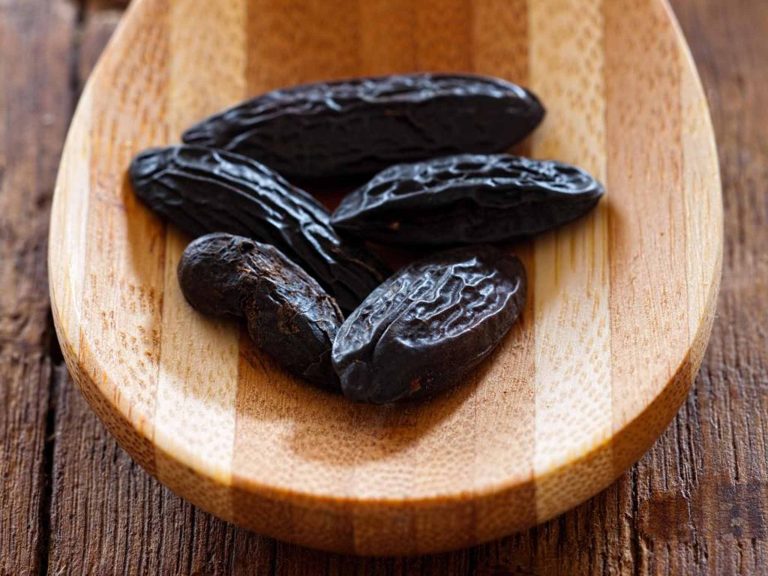
Modern amber accords often add tonka bean or a molecule called ambroxan for a brighter, more radiant, longer-lasting effect.
Here’s the detail I can’t stop thinking about. Labdanum, the backbone of the whole thing, has one of the oldest and oddest origin stories in perfumery. For roughly three thousand years, people harvested it by letting goats graze through the rockrose. The sticky resin clotted in the animals’ beards and coats, and shepherds combed it out of the hair. The Greek historian Herodotus described it in the fifth century BCE — Arabian shepherds, combing perfume out of goats’ beards. In ancient Egypt, pharaohs even wore false ceremonial beards made of goat hair soaked in the same resin. The most modern-feeling note in your collection is built on a resin that began, quite literally, in a goat’s beard.
The note is an invention. But the invention is built on something real, ancient, and Mediterranean.
What does amber smell like?
Amber reads as warm, sweet, resinous, and golden — a soft, glowing heat rather than a sharp or fresh note. But “amber” covers a spectrum, and it helps to think of two ends:
- Sweet amber: opaque, vanillic, balsamic, powdery. Think of a warm beeswax candle. This is the cozy, dessert-adjacent amber.
- Dry amber: cleaner, woody, mineral, faintly salty and skin-like. More of a warm-cotton-shirt feeling than a candle.
In my own collection, the amber I reach for most reads earthy and sweet at once — weighty the way oud or musk are weighty, but lighter and brighter than either. Once you learn to spot amber, you start noticing it holding up the base of a huge share of Middle Eastern and “oriental”-style fragrances.
Amber vs ambergris: the difference that trips everyone up
This is the mix-up I see constantly, so let’s settle it.
Ambergris is the real, whale-derived material — salty, animalic, marine, and complex, nicknamed “floating gold.” It’s genuinely rare and genuinely expensive. Because of that scarcity (and the ethics and legal restrictions around it), the industry now overwhelmingly uses a synthetic called ambroxan — derived from clary sage — to recreate its warmth and radiance. You’d be hard-pressed to find real ambergris in a modern bottle.
Amber, again, is the constructed accord (labdanum, benzoin, vanilla).
They share a name for historical reasons — “ambergris” literally means “grey amber” — but they’re different materials. The quickest proof: plenty of fragrances list both “amber” and “ambergris” separately on the same note pyramid. If they were the same thing, no one would print it twice.
The saffron connection: the world’s priciest spice, in a $15 bottle
Amber rarely travels alone in Arabian perfumery. Its most common partner is saffron — and saffron has its own myth-busting story.
Saffron is the most expensive spice in the world by weight. (You’ll hear “worth more than gold” — that part isn’t true anymore; gold is many times pricier by the gram. But the nickname “red gold” stuck for good reason.) It’s the dried thread of a crocus flower — three threads per bloom, and around 150,000 hand-picked flowers for a single kilogram, harvested at dawn in a short autumn window.
So how does a spice that precious appear on the box of a fifteen-dollar bottle? The same way amber’s whale note does: it’s mostly synthetic. Real saffron extract for perfume is astronomically expensive and rarely used, so perfumers reach for safranal, the lab-made version of saffron’s key scent molecule. The saffron glow in a six-hundred-dollar luxury bottle and the saffron in your budget Arabian favorite are, very often, the same molecule.
And saffron’s real job is subtle. On a note list it’s usually near the top, but on skin it almost never leads — it’s a sharp, leathery, honeyed spark that seasons a warm base rather than starring on its own. Push saffron to the front and it can turn medicinal, even a little like iodine. Let it ride on amber, oud, or musk, and it glows. In short: saffron seasons, it doesn’t star.
Why this matters for the “dupe” conversation
Put those two facts together and the whole “dupe” narrative starts to wobble.
Take the most hyped Western luxury fragrance of the last decade. Underneath the hype, it’s built on saffron and an amber accord — the exact pairing Arabian perfumery has worn for a thousand years, and an accord whose backbone Herodotus watched Arabian shepherds harvest. When a Gulf house releases a fragrance in that family and the internet brands it a cheap knockoff, look at what’s actually happening: the saffron is the same synthetic, the amber is the same kind of built accord, and the pairing itself was Arabian long before it was ever French.
That’s why the accurate term is designer alternative, not “dupe.” You can’t dupe a tradition by handing it back its own notes.
Affordable saffron-and-amber fragrances worth trying
These are from my own shelf — all worn and skin-tested, not pulled off a spec sheet. If you want to understand amber and saffron, start here rather than at the luxury counter.
- Orientica Amber Rouge — my front door into amber, and the bottle that made the whole accord click for me. Bright, sweet, weighty-but-light, with saffron sparking the top. If you’ve never smelled anything in the famous saffron-amber family, start here. [Buy Orientica Amber Rouge]
- Zimaya Amber Is Great — my favorite amber: woodier and a touch darker than most, spicy and sweet without tipping into dessert. Bonus: it lists amber and ambergris separately, so it’s a live demonstration of everything above. [Buy Zimaya Amber Is Great]
- Lattafa Opulent Oud — saffron and cinnamon over oud, amber, and rose. A masterclass in saffron seasoning a warm base, and it’s often under fifteen dollars. [Buy Lattafa Opulent Oud]
- Lattafa Opulent Musk — proof that saffron seasons even without amber. A spicy white musk with saffron folded so deep you can barely find it. [Buy Lattafa Opulent Musk]
- Lattafa Mohra — saffron sits right at the top of the note list here, which makes it a perfect test of the “seasons, doesn’t star” idea. [Buy Lattafa Mohra]
The takeaway
So, what is amber in perfume? A designed warmth — a fantasy accord built from real resins, anchored by a labdanum that started in a goat’s beard. Set it next to saffron, a legendary spice that mostly reaches your skin as a lab-made molecule, and you get the “warmth code” at the heart of Arabian perfumery: golden, resinous heat that was built by people, on purpose. Once you can see the recipe, you can’t unsee it — and you’ll never read a note list the same way again.
Want the full story, including the harvests, the history, and the bottles on camera? Watch the Saffron and Amber episode of Arabian Scent Files (Episode 7) on [YouTube], or listen on [Spotify link]. And if you want one email a week that goes deeper than the bottle, join The Dry Down: [newsletter signup link].